A Different Way of Seeing Security Operations
Most reviews of a guarding operation ask whether personnel are present. PAHEK was built on a different habit — noticing the exposure, drift, and blind spots that presence alone never reveals.
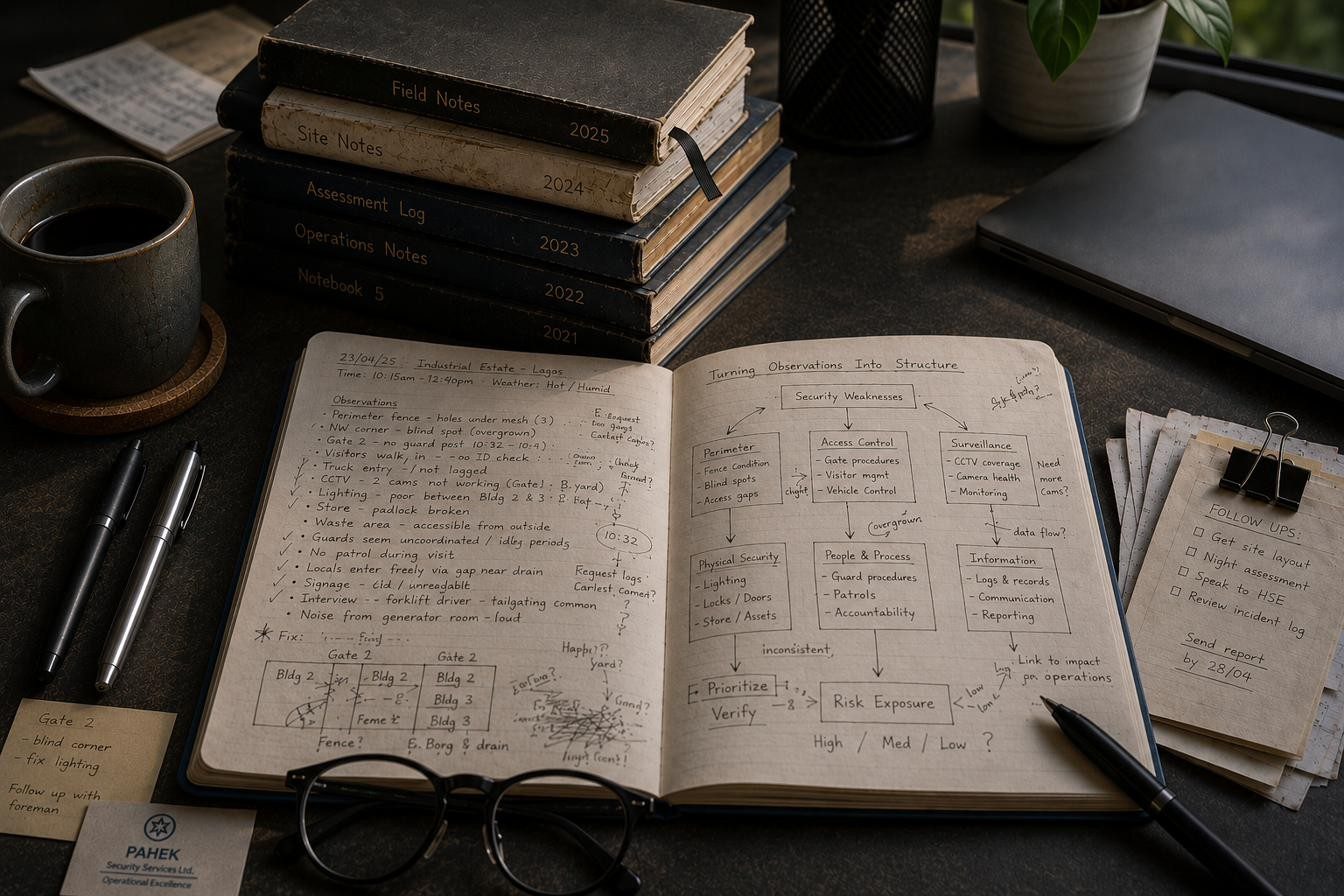
Field observations, structured into a framework, refined over years.
Formed in the Field, Not in Theory
A patrol route that looked correct on paper, until walking it revealed a gap the paperwork never showed. A supervision standard that held whenever someone was watching, and only showed its true state on the one day no one was. An assumption that worked at nine sites and quietly failed at the tenth, for a reason nobody had written down until then.
Those weren't isolated incidents. They became the beginning of a different way of seeing security operations — formed over years of site reviews, risk assessments, and deployment evaluations across construction, industrial, warehousing, and corporate environments, led by Charles Keku.
Some of these observations held up across every environment that followed. Others were rewritten when the next site contradicted them. What survived enough places, across enough years, became rigorous enough to document — eventually forming the basis of the Security Guarding Operations Blueprint.
Still Being Formed, Not Archived
This way of seeing is not a founding principle preserved from an earlier period. It continues to be tested today, through ongoing site assessments, direct client coordination, and continued involvement in the wider security industry.
Every new site still adds to what came before it. The habit of noticing has not stopped forming.
What It Built
This same habit of noticing is what built the rest of PAHEK's operational system. None of it began as a framework. It began as years of paying attention.
Accountability, Visibility, Responsiveness
Why guarding is built around an accountable system — not deployment alone.
Explore Operational Control →A Diagnosis, Not a List
Why an assessment produces a ranked understanding of what matters — not just observations.
Explore the Diagnosis →One Operating System
Why every engagement operates inside one system, sharpened by everything learned before it.
Explore the Operating System →See It Applied to Your Operation
An assessment is the first place this way of seeing gets applied to your own operation — the same habit of noticing, formed over years of direct field work, not a generic checklist.